
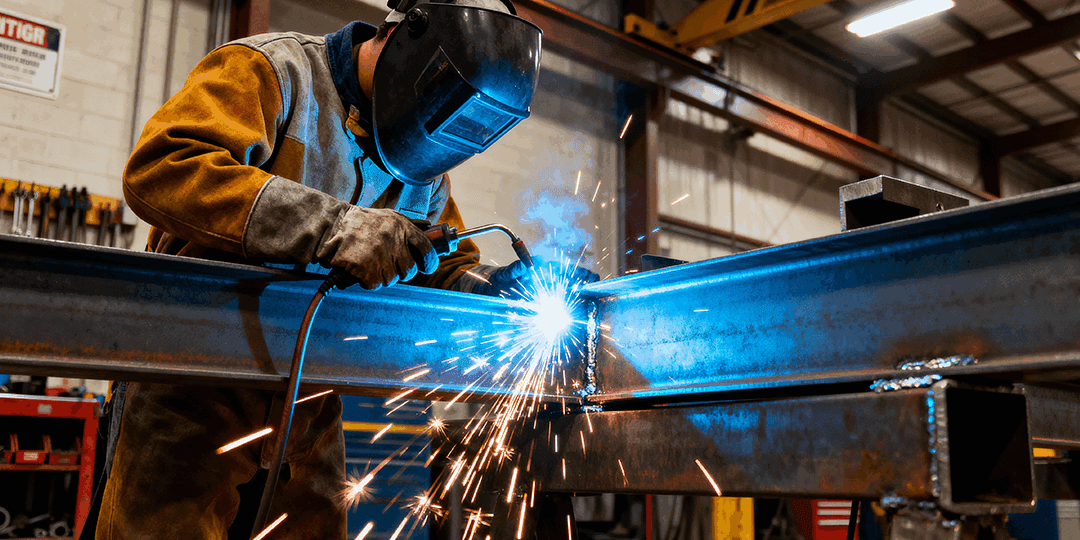
Welding makes it possible to connect metals, so they can support, redirect, and expand structures. Some metals have
high weldability — you can easily obtain an acceptable weld, even when joining them with another metal. However, not
all metals can be welded with straightforward procedures. Welding dissimilar metals can be challenging, requiring
special processes to create a secure joint.
Challenges of Welding Different Metal Types
Since each metal has unique properties, welding dissimilar metals can create flimsy connections or corrosion.
Welding problems can happen due to:
- Different melting temperatures: The melting temperatures of the two metals are vastly different,
creating internal stress in the weld. - Poor solubility: Neither metal has appreciable solubility, so they stay separate instead of
bonding at an atomic level. - Brittle intermetallic compounds: When welded, the metals create brittle intermetallic compounds
susceptible to cracking under stress. - Different thermal expansion rates: The metals expand at different rates when heat is applied,
leading to cracks, warping, and distortion.
What Metals Can Be Welded Together?
Many metals have good weldability, so they are easy to weld and retain high weld quality. Choose these metals when
welding to create durable, high-quality structures:
- Steel: Steel is one of the easiest metals to weld. Its flexibility allows it to form nearly any
shape when welding. - Stainless steel: Stainless steel is a good metal choice for welding because it’s moldable,
flexible, and durable. - Nickel: Nickel is similar to mild steel, so it is easy to weld when using the right
techniques.
What Metals Should Not Be Welded?
Some metals should not be welded due to their different metallurgical properties. These metals often result in
bonds that are too brittle, making them unsuitable for many common fabrication applications.
- Aluminum and stainless steel: Aluminum has a lower melting point than stainless steel, producing
a highly fragile compound comparable to glass. - Titanium and steel: Welding titanium to steel results in a hard weld that can crack during
cooling, forming extremely brittle compounds. - Aluminum and copper: These metals react to form a product that is prone to cracking.
How to Weld Two Different Types of Metal Together
Despite the challenges these welds may have, different metals can be welded together. You can weld dissimilar
metals to gain the advantages of each metal’s properties, save money, improve durability, and more.
There are many approaches you can take to weld different metals and ensure strong, reliable joints:
- Prepare the metals for welding: Before welding two metals, prepare both surfaces to achieve a
strong bond. Clean the metals to remove contaminants, preheat them to reduce distortion, and secure the metals to
keep them in place during welding. - Change the metals: Research other metal options that are acceptable for welding applications,
and substitute one of the metals with a more compatible material, if possible. - Transition with a third metal: Filler materials like nickel-based fillers and aluminum-silicon
fillers create strong welds for dissimilar metals. Choose a filler material compatible with both metals, place it
between the metals, and cover the surface of one of the metals with a special electrode to help form the
weld. - Use a different welding technique: Some materials cannot be joined with fusion welding, so use a
joining process like solid-state welding, adhesive joining, or mechanical fastening.
Learn More About Metal Welding Techniques
The professional team at Mid-Atlantic Steel Fabrication offers a variety of custom welding and fabrication services. We work with common metals as well as metal types that are difficult to weld. Let us meet your welding needs with
our money- and time-saving solutions. Get a custom quote by contacting us or calling 717-687-7313.